Understanding the characteristics of your heritage house and its style can help when you're planning and performing alterations and additions. Consider not just the house, but also its setting within its site and street, as well as the detail of specific design elements such as doors, windows and even stumps. Getting rooflines and the overall form of additions right is the key to successful new work.
We've produced these design guidelines to help you make the most of your existing house when planning alterations and additions. Read them together with the relevant planning controls for your area.
Poorly planned or designed alterations and additions to a heritage property will reduce its street appeal and value. Avoid making unsympathetic changes to the parts of your property visible from the street. If you must make changes, try to conserve the outward appearance and proportion of your house.
When you plan renovations, look at other houses in a similar style to yours for inspiration. Look at how varying rooflines, projecting gables and lower roofed verandahs, for example, have been used to reduce their bulk and add interest in the details. The house styles icons below provide a guide to the most common house styles in our region and their approximate construction dates. We've used them throughout these notes to help you identify the details most suited to your house.
Find out more about typical heritage house styles in the Toowoomba Region.
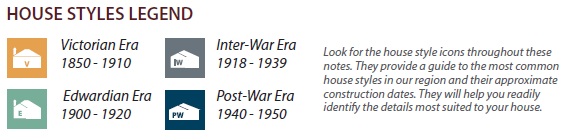
The philosophies guiding the design of alterations and additions to existing houses can be broadly categorised as either replicative, complementary or interpretive. The next section discusses each of these design approaches.
Before you start any work, you must understand the special characteristics that make your building or place unique, as these can influence the design approach. We use the term "cultural heritage significance" to describe those special characteristics or values. They can include aesthetic, historical, scientific, social or spiritual values.
Replicative
The replicative approach involves replicating the exact materials, form, details and ornamentation of the original house. Illustrations 1a and 1b show a house with a replicative verandah and wing addition.

While the replicative approach is usually acceptable, it is not recommended as it can cause confusion between the original house and the new work. Replication also requires a great deal of effort and can be expensive.
Complementary
This is a design approach in which new work complements the original house rather than replicating it exactly. This approach relies on maintaining consistent design details, such as similar building proportions, scale and overall form. It also uses similar materials and colours to the original building.
Illustrations 2a and 2b show a house with a complementary rear pavilion addition. The addition is similar to the original in proportion, scale, form and materials used but doesn't replicate it exactly.

This approach can provide a cost-effective design with minimal impact on the original building.
Interpretive
Although the interpretive approach can be successful in combining older buildings with very modern designs, it is also the most difficult of the three design approaches. It is only recommended if you engage a professional architect or designer experienced in heritage design. Because it is a bespoke approach, each case will have its own particular problems and solutions.
You must consider certain design elements and details when planning alterations and additions, to ensure you maintain your property's heritage character and significance. Any drawings must carefully document the building's existing form and detail. This will help you consider any new work in relation to the existing structure. The more detailed the drawings, the easier it is to assess the impact any change will have on the original house. You may also need to change earlier alterations or additions to be more sympathetic with the original character of the house.
The following sections provide simple examples of how you might achieve this. Although the general principles in these examples are universal, you must also consider your house's specific features when planning new work.
Building form/shape, bulk and scale
The overall form/shape, scale and bulk are the most critical elements of successful additions in heritage and character areas. New work must be carefully planned to reflect the character and scale of the original house. Typically, pre-World War II homes in the Toowoomba Region are small-scale cottages or modest houses. Illustration 3 shows a detailed drawing that captures the existing condition of the house. These sorts of drawings provide a baseline for planning sympathetic additions.

Roofs
Roofs should be simple hipped, gable or small-scale skillion, pitched to match the original building. The roof plan can influence the floorplan layout, as shown in Illustration 4. Consequently, designing a sympathetic roof form first and planning within that is a better approach than trying to fit a sympathetic roof over an already-planned extension. Flat roofs are usually not acceptable unless they are an original feature of the house.

Bulk
Elements such as projecting side gables and lower verandah type roofs help reduce the bulk of large additions. The placement of openings is another design element that can be used to reduce the mass of large expanses of wall. This can be in the form of doors and windows or open decks or verandahs.
Traditional building form
Because most old houses are small-to-modest in size, they tend to have walls and roofs of a particular scale. Illustration 5 shows examples of typical forms for houses from the Victorian, Edwardian, interwar and postwar eras.
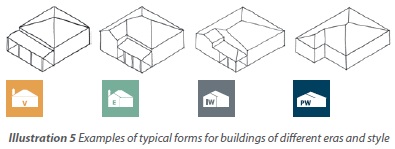
You need to keep this scale when planning additions and avoid reshaping the whole roof. As shown in Illustration 6, this usually results in an unsympathetic change in the scale of the house relative to its neighbours and streetscape. A better approach is to leave the original roof form and volume intact and express the new work separately, such as in a wing addition or linked pavilion.

Pavilion additions
If the form of your house is clearly defined, it can be difficult to extend. In this case, pavilion-style additions are recommended. This form is the most appropriate where large additions are planned. You can achieve it by introducing a link between the pavilion and the original house or by attaching the pavilion directly (see Illustration 7). The pavilion addition should be located behind the original house to minimise the impact on the street view.

You can incorporate the pavilion concept cleverly into the floor plan to create separate areas within the house. For example, the new pavilion could contain only children's bedrooms and play areas, or perhaps a parents' retreat, kitchen or family room.
Lean-to additions
Extending your house at the back in the form of a lean-to or skillion is probably the most familiar and economical type of small addition. The impact on the street facade is minimal if these additions are less than 3m deep and set behind the original house. The form, shape and size of the original house usually remain clearly visible and are not dominated by the smaller lean-to addition. However, large or conspicuous lean-to additions are generally not recommended.
The scale and roof pitch of the new work must be compatible with the building's original character (see Illustration 8). For example, the roof pitch should ideally match the pitch of any verandah roofs. An existing verandah could be extended along the side of the building to create additional space. A long extension with a minimal roof pitch is generally not recommended.

Wing additions
You can consider a wing addition if space allows on your site, and if you prefer to use the existing roof shape in the design. These additions could be a new wing or an extension of an existing wing (see Illustration 9). They're most successful where the new addition is similar in proportion, size and bulk to the original house. The new wing must not dominate the scale and form of the existing house. The roof form and pitch should match the original.

Be careful not to create long side facades that are not in proportion with the scale of the original building. Projecting bays or side wings and sections of lower roofs can be added to prevent this occurring.
Recommended addition forms
The most successful approach for large extensions is to use a combination of the pavilion, wing and lean-to building forms (see Illustration 10). Clever placement of the built elements should help ensure that the scale and bulk of new work don't overshadow the original house. This approach can also help keep a clear distinction between the original house and the new work.
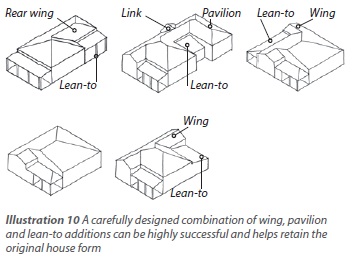
To ensure new work is compatible with old, the height of new walls, roof ridge heights and gutter lines should be the same or lower than those of the existing house (see Illustration 11). Most roof styles have an eaves or roof overhang. It is important to maintain this feature in any alterations or additions.

Window and door placement in walls
When you plan additions, you need to consider the relationship between the wall area and the area of window and door openings.
Large areas of glass are generally inappropriate. Instead, there should be groups of traditionally sized or proportioned windows. The most acceptable types of windows are those that match those of the original building, as shown in Illustration 12. These include double-hung and casement windows.

When you plan the bulk form of your additions, consider your neighbours' privacy and right to sunlight. Place windows so that they do not look directly into theirs. If this is unavoidable, try to provide privacy in the form of planting or lightweight screening.
Window sill and window head heights should also be consistent with the existing house. Most old windows are protected by window hoods. These are a practical way of blending new and old windows to complement each other.
Materials, surface finishes and building elements
Wall cladding, gutters, roofing and ventilators should complement the existing house. Although these elements should ideally be similar to those in the original house, they don't need to be exact replicas. Distinguishing between the original buildings and the new additions is also important for future historical research.
For example, the size of weatherboard or chamferboard on walls is more important than matching an exact profile. This is because the horizontal lines of the boards will be visible from a distance, but the profile could only be compared if examined in detail. Any sheet material, such as custom orb profile steel, should be laid so that the dominant lines run horizontally rather than vertically.
Box gutters are an acceptable element if a particular type of design requires their use. They must be correctly designed and maintained to ensure adequate performance.
Decorative elements
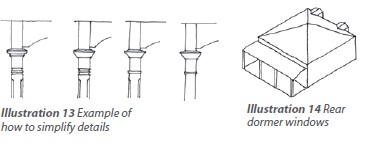
Your house may have several decorative elements such as ornate bargeboards, decorative gable ends and balustrading, or finials. Carefully consider the use of these elements in the design of your additions. Attempting to replicate them exactly can often detract from the character of the existing house. A better option may be to use certain elements from the original house but simplify or modernise them, as shown in Illustrations 13 and 14.
Two-storey attic additions
Unless your house is unusually large, creating an attic room won't give you much extra space. Not much of the under-roof volume is of habitable height.
In most houses, to use this space you'll need to punch a dormer window or two through the roof or install one or more operable skylights for light and ventilation. Dormers and skylights were seldom used on older houses. However, if you choose this option, dormers and skylights should face the rear and not be seen from the street, as shown in Illustration 14.
The typical iron roof is a fairly efficient solar collector, and the space below it becomes extremely hot in summer. If you are creating a new attic room, insulate above the ceiling to protect the inside of the house from this heat and also ventilate the attic space so the hot air can escape.
Most old timber houses have lightweight framing and were not designed to carry two-storey floor loads to today's standards. There will usually be added structural costs to make this form of addition compliant.
Second-storey additions to an existing house
The alternative to extending into the roof space is to plan for a second-storey addition. Like attics, this form of addition was rarely used on older houses in the Toowoomba Region. Adding a second storey alters the scale of a building dramatically and is not usually recommended. The scale, bulk and form of the extension need to be carefully considered, and must minimise the impact of the addition on the streetscape. Illustration 15 shows the negative impact of a two-story house on a single-storey streetscape.

Rear two-storey additions
Rear two-storey additions are not usually recommended because of their style, their visual prominence in the streetscape and their lack of compatibility with the existing house.
Basement additions
An alternative to adding a second storey in the roof of a house is to build in underneath. However, raising houses is not usually recommended as this can upset existing streetscapes of other lowset houses.
Building in underneath may occasionally be suitable where the land slopes steeply to the rear of the block and the outside walls are set behind a row of timber stumps (see Illustrations 17a, 17b and 17c). This gives the illusion that the house is still single-storey and helps to maintain the original form, scale and bulk of the building while minimising any impact on the streetscape.

When you design your additions, consider how your planned changes will impact the street and nearby buildings. The aim is to ensure your extension doesn't dominate your neighbours' houses. Illustration 18 shows the recommended types of additions. Front additions are not recommended.
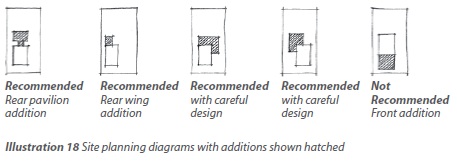
Try to minimise the visibility of any new work from the street, including additions at the rear of the building. This particularly applies where you have a wide allotment or large side boundary setbacks to either your home or adjacent buildings.
If your home is on a lot with more than one street frontage, such as on a corner, ensure the form, bulk and scale of additions or alterations complements the existing house when viewed from all street frontages.
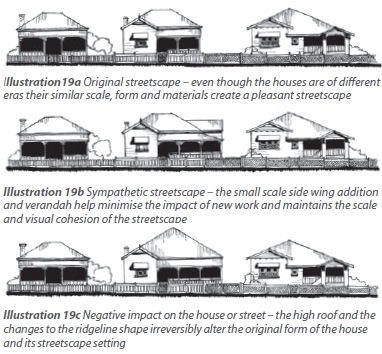
The illustrations below show how changes to a heritage house can impact a streetscape.
Illustration 19a shows the original streetscape with three houses of different eras. Despite their different ages, the houses' similar scale, form and materials create a pleasant streetscape.
In Illustration 19b, the middle house has had a side wing and verandah added. The small scale of these additions helps minimise their impact and is sympathetic to the streetscape, maintaining its scale and visual cohesion.
Illustration 19c shows an addition to the middle house that is unsympathetic to the streetscape. The high roof and changes to the ridgeline shape irreversibly alter the original form of the house and have a negative impact on the streetscape.
For books and reference guides to help with planning alterations and additions that are sympathetic to the house's character, visit the Toowoomba Region Libraries.