Location
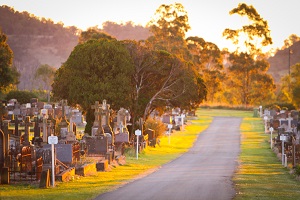
Drayton and Toowoomba Cemetery, corner Anzac Avenue and South Streets.
Cemetery open 6am to 6pm daily (parking available within the grounds).
Walking time
Allow approximately 1.5 hours for each Tombstone Trail walk.
History
Explore the rich and fascinating history of Toowoomba's early pioneers with a unique tombstone trail - a self-guided walk through the gravesites of some of the Drayton and Toowoomba Cemetery's most prominent residents.
Discover the meaning of certain headstones and gain a personal insight into the richness of the lives of Toowoomba's early residents with these five walks dedicated to the pioneers that contributed to the development of Queensland's Garden City.
The state heritage listed Drayton and Toowoomba Cemetery was established in the 19th century and is the final resting place of many of Toowoomba's most prominent citizens.
Many of the original custodians of the area - from the Giabal, Jarowair and other Aboriginal groups, are also buried here, but the exact location of their graves are unknown.
Finding your way
In the 1900s the cemetery was set out into various religious and community sectors. The cemetery is divided into various 'sections' such as CE (Church of England) and LUTH (Lutheran).
These sections are subdivided into 'blocks' with lower numbers commencing in the eastern section and the higher block numbers found to the west. Two rows of graves make one block.
Exceptions are the six RC 1 'blocks' near the Sheedy Memorial. The Old RC and Old CE sections are not clearly defined into blocks.
Block numbers run east.
Tombstone Trails map
Legend
CE: Church of England
LUTH: Lutheran
RC: Roman Catholic
PRES: Presbyterian
METH: Methodist
OLD METH: Old Methodist
OLD RC: Old Roman Catholic
OLD CE: Old Church of England
OLD BAPT & CONG: Old Baptist and Congregational
OPD: Other Protestant Denominations
Explore each of the Tombstone Trails below or view the Tombstone Trails brochure online.
Tombstone Trails - Walk One
Thomas Price
Location: Section CE 1, Block 1, Allotment 53
Thomas Price worked on large estates in England, where he gained valuable farming knowledge. When they arrived in the 1860s, he and his wife worked for a year on Gowrie Station before moving to Toowoomba. This beautiful anchor carved from a single block of marble symbolises hope in a life hereafter.
Emma Webb
Location: Section CE 1, Block 4, Allotment 45
In 1893, the first appendectomy in Australia was performed on Emma Webb on the kitchen table in her residence at the rear of her husband's bakery on the corner of Ruthven and Piper Streets. She recovered well from her ordeal and went on to outlive her doctors.
The main building of the Toowoomba Hospital is named in her honour and features an informative display about her procedure and its historic significance.
Christoph Donges
Location: Section LUTH 1, Block 3, Allotment 16
Many German labourers were indentured to owners of large stations on the Downs. Mr Donges spent the first two years on Westbrook Station before moving to Jondaryan. He married and eventually moved to Drayton where his farm was one of the best in the district. His tombstone with a biblical quotation in German contains information on his origins.
Pamela Coote
Location: Section CE4, Block 6, Allotment 4
Pamela Coote (nee Dent) was the daughter of Josiah, who was the first European to live in 'The Swamp ' later to be known as Toowoomba and was the first female child christened in Toowoomba. The Rev Benjamin Glennie baptised her in the home of Mr and Mrs Thomas Alford with their son Henry, on 29 August 1852. The name Toowoomba was used on her birth certificate and it was the first time it had been used on an official document.
William Lam Poon
Location: Section CE8, Block 6, Allotment 11
William (Lam) Poon was one of many Chinese who came to Australia seeking gold on the Palmer River field. He lived at 14 Sir Street and sold vegetables and fish. His son Hunter excelled at sport and taught at Toowoomba High School for many years.
Tombstone Trails - Walk Two
Josiah Dent
Location: Section CE 13-18, Block 15, Allotment 37
Josiah Dent was probably the first European to live in "The Swamp,'' later to be known as Toowoomba. He was found living in a tent where the entry to the Myer store is today (Dent Street). There
is a garden there now. After his marriage, he built a house near the present CWA (Country Women's Association) rooms in Margaret Street. His daughter Pamela was the first female child christened in Toowoomba.
George Essex Evans
Location: Section CE 19-24, Block 19, Allotment 60
In 1903 the poet George Essex Evans was the driving force behind the formation of Toowoomba's Austral Society. His poems 'The Women of the West' and 'The Nation Builders' were well known to Queensland school children who learnt them from their reading books. Essex Evans died in 1909 at the age of only 46 and this 'life cut short' is commemorated in the broken column design of his headstone.
Samuel Horsfall
Location: Section CE 19-24, Block 24, Allotment 44
The Drayton orchard of Samuel Horsfall was renowned throughout the Downs for its cleanliness and successful treatment of the fruit fly menace where he showed what could be achieved. The obelisk design has been used since ancient Egyptian times and signifies eternity.
The "Eulo Queen"
Location: Public 1, Block 48, Allotment 72
Born in Mauritius, Isobel Graynee Richardson became a famous figure in the town of Eulo where she owned a number of hotels that she managed with legendary strength. She married more than once and was renowned for wearing her beloved opal encrusted corset after her love of opals. She died in Toowoomba in 1929.
Frederick Kretschmar
Location: LUTH 2, Block 3, Allotment 2
Kretschmar's Band was well-known in Toowoomba. Mr Kretschmar passed on his expertise to many bandsmen contributing significantly to the musical development of Toowoomba.
Tombstone Trails - Walk Three
Nellie Elizabeth Robinson
Location: Section OLD CE 1, Block 4, Allotment 53
Nell was the first woman Mayor in Queensland after her election in April 1967 and held the position for almost 15 years. Nell studied dramatic art in London then returned home to help in the war effort, later teaching at Fairholme. She was awarded an OBE in 1979.
William Beit
Location: Section OLD CE 2, Block 16, Allotment 24
William Beil married Mary Kellett and to mark the occasion they resolved to build a homestead. John McLean (Colonial Treasurer of Queensland) and William Beil bought the land in 1853, on which Westbrook Homestead was eventually built a kilometre from the main Pittsworth highway just beyond Westbrook Creek.
William Henry Groom
Location: Section OLD CE 1, Block 12, Allotment 9
William Henry Groom arrived in Australia in 1849 as a boy of 16 years, convicted of stealing in England three years previously. He became an auctioneer in 1858. Over the next 43 years, he became respected and influential and could be named the father of Toowoomba. He was Toowoomba's first Mayor elected in 1861.
He led his Council in acquiring land for the Town Hall and funds for the establishment of the General Hospital and Willowburn Hospital, now Baillie Henderson. He died of a combination of 'bronchial catarrh' and heart failure on 8 August 1901.
Thomas Trevethan
Location: Section OLD BAPT & CONG, Block 5, Allotment 67
Thomas Trevethan was born in Cornwall, England and died 21 September 1891 aged 47 years. He was a coachbuilder, Alderman and became Mayor in 1888. Thomas Trevethan Junior, with his uncle Walter, built the first Queensland car in their Neil Street factory in 1902. It was a single-cylinder 6hp Dion engine buggy.
Henry Spiro
Location: Section JEWISH 1, Block 3, Allotment 24 & 25
Henry Spiro, the only German/Jewish Mayor of Toowoomba was elected in 1873 and died on 10 December 1876, aged 36 years and two months. He was instrumental in building the first Jewish Synagogue in Queensland situated in Neil Street. His monument is inscribed in Hebrew and English.
Tombstone Trails - Walk Four
William Gentle
Location: Section OLD RC 2, Block 1, Allotment 21
The brothers William and Peter Gentle were Toowoomba hoteliers. Peter's hotel The Horse and Jockey, is now known as the Shamrock. William owned land where the present Gentle Street is located.
Thomas Perkins
Location: Section OLD RC 2, Block 4, Allotment 4
In 1869 the brothers Patrick and Thomas Perkins constructed a large brewery in Margaret Street on the site now occupied by Grand Central Shopping Centre. The brewery produced more than 25,000 gallons of XXX beer per week, making it one of the largest in the southern hemisphere. Thomas died on 10 August 1876 from injuries accidentally received at the age of 35.
Major James Tolmie
Location: Section OLD PRES 1, Block 4, Allotment 42
James was a part-owner of the Darling Downs Gazette and also a parliamentarian. His sister, Helen (Ella) Tolmie was the first probationer engaged at the Toowoomba General Hospital and was said to have assisted at Emma Webb's appendectomy. She was appointed to Matron of the General Hospital in 1897 and is interred with her brother.
Sir Hugh Nelson
Location: Section OLD PRES 1, Block 7, Allotment 35
Sir Hugh Nelson was the President of the Legislative Council, Lieutenant Governor of Queensland, Queensland Treasurer and State Premier. Sir Hugh Nelson lived at historic Gabbinbar, which was built in 1863. Gabbinbar is situated at the southern end of Ramsay Street. Sir Hugh Nelson's father was the Rev William Lambie Nelson, the first minister of St Stephens, Presbyterian Church.
John and Sarah Devine
Location: Section OLD PRES 1, Block 11, Allotment 3
John, Sarah and their three children arrived in Brisbane on the 'Lady Douglas' in June 1874. John Devine and his wife Sarah farmed in the Vale View area South of Toowoomba until he became Sexton of the Drayton and Toowoomba Cemetery on 1 March 1875. This began 86 years of continuous service by three generations of Devines to the cemetery.
A descendant Mrs Davison (nee Devine) pointed out that John's surname was originally Diffin but on leaving the ship, which brought them from Ireland, his surname had changed from Diffin to Devine. No apparent reason is known for this but Mrs Davison mused that it may have been on account of pronouncing the name 'Diffin' as 'Devine'.
Tombstone Trails - Walk Five
O'Brien Family
Location: Section RC 1, Block 14, Allotment 19
Patrick and Ellen O'Brien were married in 1884 and established a store in Russell Street. In 1899 with then partner George Crisp, they opened a flour mill in Russell Street in 'defiance' of the existing Dominion Mill. Operations were later moved to the existing premises in Ruthven Street. Mrs O'Brien managed the company following the death of her husband. At the time she had ten children.
Timothy Spillane
Location: Section RC 1, Block 22, Allotment 14
Timothy Spillane was the husband of Margaret. Spillane was charged with Michael Irwin's murder but his wife's confession later caused his release.
Michael Irwin
Location: Section RC 1, Block 24, Allotment 41
Michael Irwin died from blows inflicted to the head by Margaret Spillane, in her fowl house. In testimony, she said, 'I thought he was a Chinaman'. Mrs Spillane was sentenced to death, but this was later reduced to life imprisonment. She was imprisoned in the Toowoomba Jail, which was located in Margaret Street. The jail's foundations are still visible at the end of Stirling Street.
Michael Daniel Pigott
Location: Section RC 4, Block 1, Allotment 22
Michael was the founder of Pigott and Co and established a retailing business in Toowoomba after he broke away from his Brisbane partner Bierne.
John McKinney
Location: Section PRES 3, Block 12, Allotment 29
John McKinney left Ireland in 1881 at the age of 19, for Australia. In 1885 he established the House of McKinney that began as a tobacconist and hairdresser at the top end of Ruthven Street. During the war, the business grew and by 1927 John McKinney passed the reins over to his son. Toowoomba's store extended from Ruthven Street over Dugan Street to Victoria Street.
Acknowledgement
Trails and content compiled by Toowoomba Regional Council, the Drayton and Toowoomba Cemetery and Peter Cullen of the Toowoomba Historical Society.