Preserving original paint finishes or reinstating a building's colour scheme helps retain and enhance its historical significance. It can also complement the house's architectural and decorative elements.
Often you'll be able to gather a combination of evidence to build up a picture of the intent of the original colour scheme. Even if you can't determine the exact colours, research can lead to greater understanding of the colour placement. This is equally important for selecting colours that relate to the building's architectural form and decorative details.
There are several ways to find your house's original colours.
Paint traces
Traces of the building's original colour may still exist. These are often found during restoration work, especially behind fittings such as cupboards, doors, windows, electrical wiring or switches. You can take paint scrapes using a Stanley knife or scalpel (Illustration 1). These may reveal the layers of colours that the building has been painted with over time.
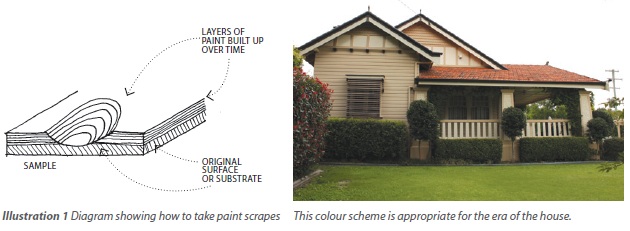
For the most accurate match, choose areas where the paint has had the least weathering or likelihood of having been disturbed. These include under sills or window hoods or in shaded areas. Also investigate and scrape different areas of a wall or architectural features such as doors, windows, verandah posts, gable fretwork and other decorative elements, as colour can vary.
Once you've taken a scraping, you can examine old paint colours with a magnifying glass or microscope. Depending on the accuracy you need, you can then match them to:
- a manufacturers' colour chart
- Australian or British standard paint charts
- the Munsell colour system.
As you go, record the location and colour of each paint scrape, starting with the base and ending with the current layer. Understanding how a colour fades can help you to identify how it changes through sunlight exposure. For example, Brunswick green fades to a light blue, and red paint fades more quickly than most other colours. Also remember to distinguish the original finishing coat from the primer or the undercoat. For example, Victorian-era primers were usually off-white or cream, or sometimes red due to lead pigment.
You may like to consult a specialist with expertise in analysing early paints and use of finishes. They can be especially helpful for paint analysis of larger or complex structures, or for uncovering fine details, design or work, such as stencilling, dados and other types of decoration.
Documentary sources
Documentary evidence of early colour schemes may also be helpful. These include:
- photographs
- books on colour schemes and restoration
- period publications and books
- other similar buildings that are either in an original state or have been professionally restored.
Photographs
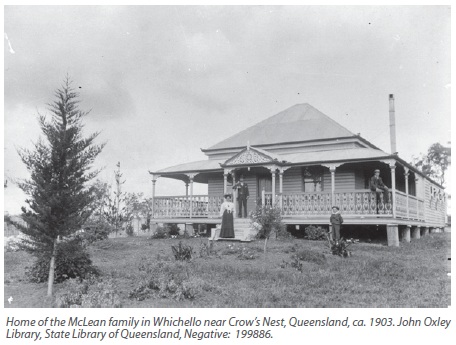
Photographs, even in black-and-white, are useful as they show dark and light tones and placement of contrasting colours. Although you may not always find an image of your particular building, images of buildings from a similar period can still be helpful.
You can find period photographs through:
- neighbours, previous owners or occupants
- local libraries, museums and historical or genealogy societies
- period publications, such as Home Beautiful and The Architectural and Building Journal of Queensland
- the State Library of Queensland, especially the Picture Queensland collection.
Historical documents
Occasionally it is possible to find historical documents that relate to your building. These include:
- original building specifications
- drawings, sketches or early paintings
- diaries, letters or stories providing written descriptions of buildings.
Buildings of civic importance often appear in local newspapers with descriptions of finishes and colours. The social pages of period publications can also be a great source of information. These often contain articles of "at homes" or other gatherings that also include descriptions of the house.